
Frozen food has a way of spreading. A few bags of vegetables become stock, baking supplies, ice, and meals saved for a busy week. The right freezer plan starts with where those things should live, not with a stainless-steel door on a drawing.
Quick Answer: Freezer Column or Freezer Drawers?
Choose a full-height freezer column when frozen food is a major part of the household’s storage plan and you need one organized, higher-capacity location. Choose undercounter freezer drawers when you want a smaller second freezing zone near prep, baking, or entertaining. Drawers are usually a supplement to a main freezer, not a direct capacity replacement for a column. Compare usable interior space, reach, door or drawer clearance, and model-specific installation requirements.
Think in Zones, Not Just Cubic Feet
A freezer column can keep bulk groceries, batch-cooked meals, and larger packages together in the main kitchen. It may be paired with a separate refrigerator column to create a custom storage wall. That is valuable when the family shops in larger quantities or cooks ahead often. The tradeoff is a tall cabinet opening and a door swing that must clear adjacent walls, islands, and handles.
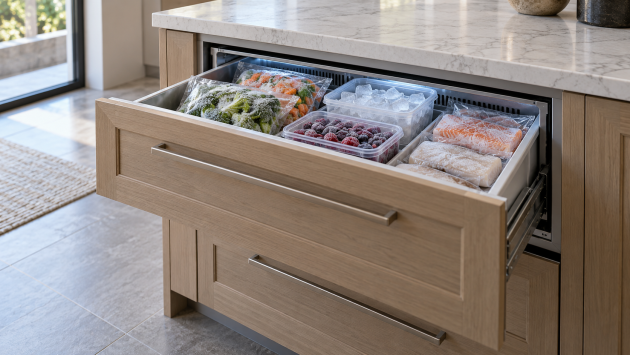
Undercounter freezer drawers can put frozen fruit near a breakfast station, ice and mixers near a bar, or prepared ingredients near the cooking zone. Sub-Zero lists both column freezers and 24-inch freezer drawers, but interior dimensions and features differ by model. A pair of convenient drawers can reduce trips to the main freezer while still leaving the main cold-storage plan intact.
Freezer Column vs Freezer Drawers at a Glance
| Decision | Freezer Column | Undercounter Freezer Drawers |
|---|---|---|
| Best role | Primary frozen-food storage | Secondary, task-specific storage |
| Cabinet location | Full-height appliance wall | Island or base cabinet run |
| Access | Mix of standing and lower-level reach | Top-down view; lower drawer requires bending |
| Clearance | Door swing and rack access | Full drawer extension into the aisle |
| Visual effect | Large appliance or panel-ready wall | Concealed low cabinet fronts |
Test Your Frozen-Food Inventory
List the items you routinely freeze and note their package sizes. A column may make sense for frozen meals, meat, bulk purchases, and large containers. Drawers are easier to justify when the contents have a specific nearby use. Organizers can help, but do not assume a deep drawer will hold every pizza box or stock container upright. Measure the items that cause trouble in your current freezer.
Placement affects how pleasant the storage is to use. A freezer drawer directly across a narrow island aisle can block movement when fully extended. A column beside a wall may need more hinge clearance than the floor plan suggests. Stand at the planned location and mimic opening the appliance while someone else passes behind you.
Installation and Long-Term Flexibility
Choose the exact model before cabinet dimensions are finalized. Confirm the finished opening, electrical location, ventilation path, anti-tip or support requirements, panel dimensions where applicable, and service access from the manufacturer’s installation guide. If an ice maker is included, water supply and filtration may add another planning step.
For households still deciding on the full refrigeration wall, our column versus French-door refrigerator guide covers the broader layout choice.
Frequently Asked Questions
Can freezer drawers replace a full-size freezer?
Usually not for a household that stores bulk groceries or many frozen meals. They work best as convenient secondary storage, though the answer depends on the chosen model and your habits.
Do panel-ready freezer drawers need special cabinets?
They need a model-specific opening and compatible panels, handles, clearances, electrical service, and ventilation. Give the cabinet maker the installation instructions before fabrication.
Which is easier to organize?
A column offers more vertical separation, while drawers make a smaller collection visible from above. The better layout depends on package sizes and whether you group food by meal, ingredient, or location.
The sensible choice is the one that keeps frozen food near the work it supports without giving the kitchen more appliance than it needs.