
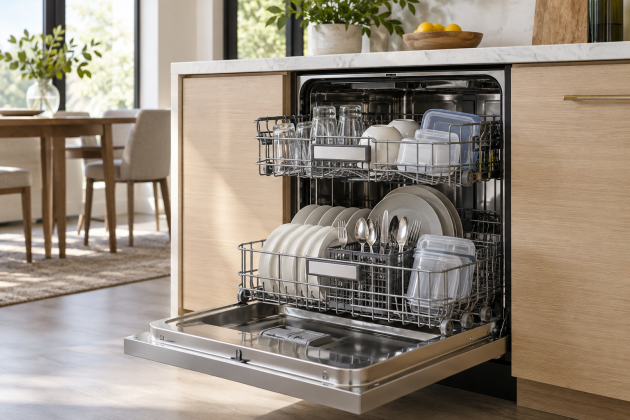
The dishes are clean, the glasses are dry, and the plastic containers still need a towel. That familiar result is worth paying attention to when you shop for a dishwasher. Drying is a separate part of performance, and the technology behind it varies even among premium models.
Quick Answer: Which Dishwasher Dries Plastics Best?
If dry plastics are a top priority, look for a model with a drying system specifically designed to improve plastic drying, then compare independent results or see the appliance in action. Condensation drying is gentle and common in premium dishwashers, but lightweight plastics often stay damp. Automatic door-opening systems vent moisture after the cycle. Mineral-assisted systems add heat to improve drying. None can promise every item will be completely dry when water pools in a lid or container rim.
Why Plastic Behaves Differently
Condensation drying uses the heat retained by dishes after a hot final rinse. Moisture moves toward the cooler tub walls and drains away. Glass, metal, and ceramic hold heat better than many plastic pieces, so they often dry first. A concave lid can also collect water regardless of the machine’s drying method.
Bosch describes condensation drying as the foundation of its dishwasher systems. Its guidance also points to rinse aid and loading as meaningful parts of the result. That matters because a premium drying feature cannot compensate for nested bowls or a container placed where water cannot drain.
Three Common Drying Approaches
| System | How It Works | What to Ask |
|---|---|---|
| Condensation drying | Uses hot dishes and cooler tub surfaces to move moisture away | Are there extra-dry settings, and how are plastics handled? |
| Automatic door opening | Opens the door near the end of the cycle to release humid air | How far does it open, and is the nearby cabinetry suitable? |
| Mineral-assisted drying | Uses a mineral system to turn moisture into heat | Which models include it, and what results apply to mixed loads? |
Bosch offers examples of all three approaches: PureDry, AutoAir, and CrystalDry on select models. Bosch reports that CrystalDry improved drying in its own mixed-load test compared with PureDry. That is a manufacturer comparison, not a guarantee that every container or lid will be dry. Check the current model’s features rather than assuming an entire brand line uses one technology.
What the Dishwasher Needs From You
Rinse aid helps water sheet off surfaces. Bosch recommends it even with advanced drying systems. Put cups and containers at an angle so they drain, avoid overlapping plastic pieces, and unload the lower rack first so water from an upper item does not fall onto clean dishes below.
Cycle choice also matters. An eco program, a quick cycle, and a sanitation or extra-dry option may end with different heat and timing. Consult the model’s manual if drying is disappointing before deciding the appliance is defective. A wet load can have a simple cause: an empty rinse-aid dispenser, a short cycle, or a cluster of nested containers.
Plan for the Kitchen Around the Machine
An automatic-opening door is helpful when you want humid air out of the tub, but it is also a physical movement in the room. Confirm that the door and any steam-management features are compatible with the cabinet panel, counter edge, and walkway. Ask the installer about the manufacturer’s specific requirements.
If your dishwasher is in an open kitchen, balance drying with the other features you notice every day: rack flexibility, noise, handle design, and service access. Our panel-ready dishwasher planning guide covers the fit and cabinetry questions.
Frequently Asked Questions
Why are my plastic containers wet but glasses dry?
Plastics often retain less heat after the final rinse, making condensation drying less effective on them. Flat lids and recessed rims can also hold standing water.
Is an automatically opening dishwasher door safe for my cabinets?
It depends on the appliance design and its installation requirements. Review the exact model’s instructions with the cabinetmaker and installer, especially for a custom panel or sensitive countertop edge.
Should I use rinse aid with a premium dishwasher?
Usually yes, if the manufacturer recommends it. Rinse aid helps water move off dishes and can improve drying even when the appliance has a specialized drying feature.
Can any dishwasher dry every plastic lid?
No system can remove water trapped in a deep recess or pooled on a flat surface every time. Load pieces at an angle and leave space around them. Judge drying performance on the kinds of items you actually use.
The best drying system is the one that solves your real annoyance without making the dishwasher harder to live with. Take a photo of your usual plastic-heavy load when you shop; it is more useful than a showroom full of perfectly spaced plates.