
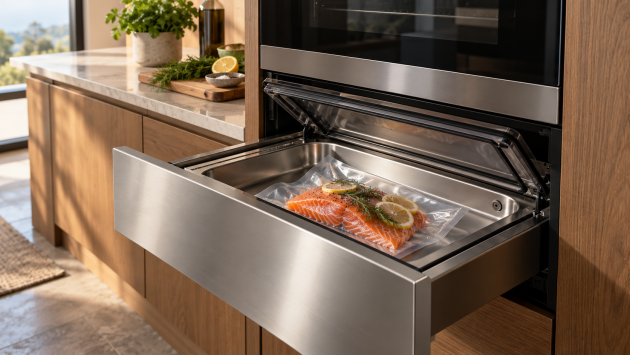
A vacuum sealer can earn its place in a kitchen after one productive cooking day: portion the fish, pack the extra soup, and make room in the freezer. The harder question is where the sealer should live. A countertop appliance can be put away; a built-in chamber drawer needs a permanent cabinet opening.
Quick Answer: Built-In Drawer or Countertop Sealer?
Choose a countertop vacuum sealer if you seal food occasionally, want to spend less, or need the flexibility to move the appliance. Consider a built-in vacuum-sealing drawer if you prep and freeze food frequently, cook sous vide, want a clear countertop, and have room in the cabinet plan. Chamber drawers can handle some liquids and delicate foods more comfortably than basic external-suction sealers, but capabilities vary by model. Neither choice replaces safe refrigeration, freezing, or food-handling practices.
The Two Machines Work Differently
Many countertop sealers draw air out through the open edge of a bag before closing it. They can be practical for dry portions such as meat, vegetables, and pantry ingredients. Their small footprint is appealing, although the machine, bag rolls, and accessories still need storage. Wet foods may require special handling or a model designed for them.
A built-in chamber drawer puts the bag inside the appliance and removes air from the chamber. Miele describes its vacuum drawer as suitable for portioning, freezing leftovers, and preparing food for sous-vide cooking, including some liquid-filled bags. Wolf offers adjustable vacuum and seal settings in its drawer. These are useful capabilities, but the selected model’s bag sizes, fill limits, accessories, and instructions matter.
Compare the Real Kitchen Tradeoffs
| Decision | Built-In Vacuum Drawer | Countertop Sealer |
|---|---|---|
| Location | Permanent cabinet opening | Countertop or storage cabinet |
| Cost and commitment | Higher appliance and installation commitment | Lower entry cost and easy replacement |
| Counter space | Keeps the worktop clear | Needs a landing space during use |
| Wet or delicate foods | Some chamber models support them | Depends strongly on sealer design |
| Future changes | Cabinet dimensions may limit replacement | Easy to move or upgrade |
Who Will Actually Use It?
If you seal a few portions after a monthly grocery trip, a countertop sealer may be enough. The drawer becomes easier to justify when sealing is part of a weekly routine: bulk shopping, batch cooking, freezing sauces, or prepping ingredients for sous vide. A dedicated appliance is convenient only when its bags, labels, and cleaning supplies are close at hand.
Think about the other half of the workflow too. Where will packed food cool safely before sealing? Is there organized freezer storage nearby? Can the sealed packages lie flat or stand upright where you intend to keep them? A premium drawer will not solve a freezer that is already overfilled.
Cabinet and Safety Planning
Choose an exact model before cabinetry is finalized. Check the opening, electrical requirements, drawer extension, comfortable working height, bag and container dimensions, and service access in the installation guide. A drawer tucked too low may be tiring to use; one beneath another appliance must still leave practical access to both.
Vacuum sealing is packaging, not canning or sterilizing. Follow the manufacturer’s food guidance and keep perishable foods at appropriate temperatures. Wolf explicitly notes that the vacuum-only jar function on its drawer is not intended for canning or making jam. Also follow the model’s instructions for warm foods, liquids, glass containers, and bag fill levels.
Frequently Asked Questions
Is a built-in vacuum drawer worth it?
It can be for a household that seals food routinely and values a clear counter and integrated prep station. For occasional use, a portable sealer is usually the simpler choice.
Can a vacuum drawer seal soup?
Some chamber drawers can seal liquids, but fill limits and operating instructions vary. Check the exact model and let hot food cool according to food-safety guidance before packaging.
Does vacuum sealing make food shelf-stable?
No. Perishable food still needs appropriate refrigeration or freezing. A vacuum seal is not a substitute for approved canning or safe food storage.
Start with your routine, then choose the machine. The best sealer is the one you can use, clean, and store without turning food prep into another project.