Are All Laundry Machines Stackable?

The short answer is no. Although many homeowners want to make the most of their laundry space by placing one machine on top of another, this is only sometimes possible. Certain manufacturers have designed their machines to be compatible, but this may not extend to others. Stacking your laundry appliances within the same brand and model range as you like may be possible. This article will examine stacking laundry machines to help you make informed buying decisions.

The Types of Laundry Machines That Can Be Stacked

It’s important to remember that you can only stack front-load laundry appliances. This may seem strange, but there are many examples of people buying top-loading machines only to discover that they can’t put another appliance on top of them!

It’s also fairly standard practice to stack dryers on top of washers. Why? There are two main reasons. First, the washer is heavier, and this is especially true if it’s full of water. Second, it will be necessary to plumb a washer into the water supply and drain, which tends to be lower on the wall of your laundry room. Although installing a washer and dryer in the opposite configuration is possible, this is not advisable.

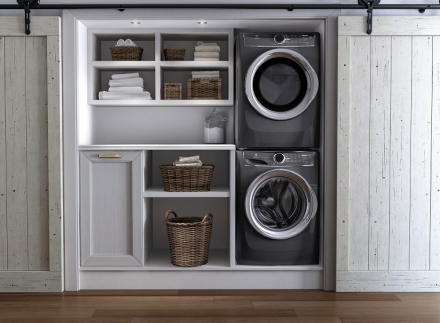
So, if you want two machines to wash and dry simultaneously, you will need a pair of front-loading models. To promote compatibility, they should be from the same manufacturer and product lineup. The alternative is to avoid using two models and use a combination washer/dryer with a top-load washer door. If you’re considering this route, please remember that the washer door may only open up to a 45º angle.

All front-loading laundry machines have the controls mounted on the front of the appliance. This is important because you will need ready access to the controls without trying to reach behind or on top. There are three different stable laundry units that you should consider using compatible machines. They are:

  • Compact Units: These are two laundry machines that are distinct from each other, but you want to connect them anyway. This is common when people buy a new machine and don’t want to get rid of the different model because it’s working well. The good news is that compact units are smaller, the dryer should be condensation-free, and there will be fewer choices to make. In this case, the best option is to buy a separate stacking kit for each machine to join them together.
  • Laundry Centers: These are washers, dryers, and stacking kits contained in a single unit. This guarantees compatibility out of the box, the owner’s manuals cover troubleshooting, and the process should be hassle-free.
  • Standard Front Load Machines: These are full-sized front-load washers and dryers that can be stacked side by side or on each other as required. They are typically bought separately, and compatibility is not guaranteed. Some research may be necessary, and a stacking kit will be a separate purchase, too. The usual rules apply: the dryer will be stacked on the washer.

Check the Space Requirements

It’s essential to carefully measure the space where you want to stack your dryer on top of your washer. Many people install their machines in an enclosed area or closet to best use the space. This is a great idea, but leaving at least a few inches on each side for ventilation and access is essential. There may be times when you need to pull the machines out to check a connector or hose. This can be extremely difficult if you cannot purchase on the machines’ sides.

Many people need to remember about the door. Make sure that the closet is sufficiently deep to accommodate the laundry machines. If it isn’t deep enough, you may find that you cannot close the closet door!

Are There Any Stacking Disadvantages?

Yes. The main problem is that some capacity may need to be sacrificed to make this configuration work. A regular load isn’t a problem, but if you plan to wash heavier items like bedding and blankets, there may be a problem. Another potential drawback is that if one of the compatible machines fails and you want to replace it, you have limited options. The new machine must be compatible with your remaining machine, or you won’t be able to stack it. This is a significant problem with laundry centers that can be difficult to deal with regarding repairs and replacements. In truth, aside from the space-saving aspects of stacking, there are no other significant advantages. If you have the space, installing the two machines alongside each other is better.

How Do I Stack Laundry Appliances?

The first step is to ensure the dryer can be stacked on the washer. A manufacturer’s product range usually has broad compatibility. However, it may be possible to stack two machines from different manufacturers. To check if the machines can be stacked, look for specific details in the user manuals for those models. This information can also be found on the manufacturers’ websites.

If you’re sure the laundry appliances can be stacked, you’ll need some physical way to do it. Stack kits for specific laundry appliances can usually be found at appliance retailers and online. A stacking kit comprises metal brackets used to securely and safely join the two appliances. These can represent a significant investment, but they take much guesswork out of the process and are easy to use.

For brevity, here are eight simple steps to stack your dryer on top of your washer:

  • Tools and Items: You will need the stacking kit, owner’s manual for both machines, a level, measuring table, screwdriver, adjustable wrench, adhesive foam pads, lifting straps, cardboard sheets, and a friend.
  • Check the Manual: Double-check that the two machines are compatible. This will determine whether you have the correct stacking kit.
  • Prepare the Space: Remember that the space needs to be deep enough for the machines; you need around 3 inches down the sides and 6 inches of clearance at the top.
  • Prepare the Appliances: Put the cardboard on the floor, place the dryer on it, lean it over carefully, and remove the foot screws with the wrench. Get the stacking feet from the kit and thread them onto the base of the dryer. Keep the legs safe; you may want to change the configuration later or sell the machine.
  • Positioning: Move the washer into position, leaving a couple of inches for stacking clothes, and ensure the appliance is level. Slide the dryer over on the cardboard sheet to protect the floor and stack it on top using foam pads. You will need two people for this stage and may want to use lifting straps, too. The front and sides of the dryer should be flush with the washer.
  • The Brackets and Clips: Now, you can attach the two appliances to prevent lateral movement when they are operating. All brackets and clips should be installed according to the instructions on the lower edges using the screwdriver. Some alignment may be required to get the fit right before the screws are fully tightened.
  • Make the Connections: Connect the water, gas, vent, and power and ensure that everything is tight before the stacked machines are carefully slid into their final position.
  • Testing: Run an empty washer and dryer cycle to ensure everything works typically. Watch for sudden movements or complex vibrations that indicate that the machines are not level or that the stacking kit wasn’t appropriately used.

Safety Considerations

Some people take a risk and place their dryer on top of the washer without using a stacking kit. This is a bad idea because dryers tend to sway as they operate, and it’s difficult for them to work off the top of the washer.

Ultimately, this may cause damage to both machines, which could be expensive to fix. In extreme cases, it may lead to an earlier-than-expected replacement, costing even more. However, installing built-in shelves to house the machines may not be the best option. The dryer could still move and fall, as we covered in the previous scenario. Also, going this route may cost more than a stacking kit, which would be safer and more secure.

In Conclusion

Choose a home appliance specialist if you’re looking for compatible front-load washers and dryers and the stacking kits to connect them. They can offer helpful advice on the best models to meet your needs and space requirements.


All You Need to Know About Ventless Dryers

Approximately 80% of homes in America have a clothes dryer, and if you don’t, you may find yourself collecting quarters to visit the laundromat. If you are limited for space, you may think that you are stuck using those giant machines and waiting around for an hour, but there is another option; the ventless dryer. These appliances are not considered mainstream here in America, but they have been used in Europe for decades. So, here we will explore all you need to know about these great devices.

Why Ventless Dryers are Popular in Europe

If you visit many European countries, a ventless dryer is considered standard and use it just as we would use our conventional dryers. The reason why these appliances are so prevalent in Europe is that European homes tend to be far smaller than a typical U.S home and they just cannot accommodate the large, vented dryers we have here. This means that if you have a smaller home, you can take inspiration from the Europeans and opt for a ventless dryer.

Ventless models can fit under a counter or even in a closet, provided there is proper airflow and an electric socket. If you do use your dryer in a closet, you will need to open the doors while you’re drying to maintain air circulation. Another attractive feature of a ventless dryer is that they can be stacked or placed side by side with your washer. This means that you can save space. For example, you could create a dining table over your washer and dryer in your kitchen to create an area for eating when you’re not doing laundry.

How Ventless Dryers Work

Vented dryers pull air from the laundry room to be heated. The air is rolled around with the clothes before it is blown out the exhaust with any evaporated moisture. In order to vent this exhaust, there needs to be a hole in the wall, but this can create problems. For example, when the air is cold, your home won’t be warmed up, so the furnace needs to work harder to compensate. The reverse can also be true; if you are drying in summer, you’ve paid money to cool your indoor air only for your dryer to warm it up again.

A ventless dryer does not need exhaust. While it does pull in cool air to heat it up, it uses a heat exchanger to cool the heated air and draw the moisture into a containment chamber. This cycle is repeated until the clothes are dried. There is no need to vent any exhaust as the water is either collected in a tray or passed down the drain.

The Benefits of a Ventless Dryer

There are numerous benefits of using a ventless dryer, but the most obvious is that there is no need to punch a hole in your wall. This also means that you’re not wasting energy heating or cooling air with your HVAC system only for it to be channeled outside.

Ventless drying is also more gentle on your clothing. You’ll find that your clothes come out of the dryer cooler. Although you may enjoy that “toasty, warm” feel from your dryer, this is not great for the fabric. In fact, the heat of a vented dryer can cause over-drying and create fading, color running or shrinking.

Ventless dryers also tend to be more economical. Not only are they less expensive to install, but they typically use 30% less energy compared to traditional models. There is also less chance of clogging as there is no vent to accumulate lint and debris to create a fire risk. So, while it does take a little longer for your clothes to dry, it should have a positive impact on your energy bills.

If you’re considering a new dryer, you can explore your options with this online collection or dryers, or for further help or guidance, speak to a laundry appliance expert.

Why Your Dryer Needs to be a Clutter Free Zone

Most of us find our laundry room end up being a bit of a dumping ground. It is very easy to leave clothing on top of the dryer, but allowing your dryer to become cluttered is a possible safety risk and could be putting your home at risk of a fire.

The Real Possibility of a Fire Hazard

While you may be diligent about emptying your lint trap, leaving clothes on top of the dryer, while you are doing multiple loads of laundry, creates a real risk of fire. If clothes are left while the dryer is running, you can not only compromise the dryer performance, but could be putting your home in danger.

Dryers produce a great deal of heat in order to dry wet clothing. This requires space so that the heat produced can safely escape. When clothing is piled on the dryer, there is a risk that they will fall off the top of the dryer and get wedged behind the appliance. This is likely to block the vents and allow heat to build up. Additionally, since most clothing materials are flammable, there is an even greater chance of an item igniting.

Safer Ways to Store Dried Clothing

If you’re dealing with multiple loads of laundry, it is inevitable that some clothing will need to be stored temporarily until they are folded and put away. Fortunately, there are safer ways to store your dried clothing without putting your laundry room at risk of a fire.
One of the easiest ways to store your dried loads is to use a laundry basket. A laundry basket on the floor near your drier can be used for clothing straight out of the dryer, or provide a place for folded clothes.

If you like to keep everything organized in your laundry room and prefer to fold everything before it is taken to your bedroom, you could set up a table. A table can provide a place to unload the dryer or fold your clothing. If you are limited space, consider a folding table that can be collapsed when you don’t need it.

Another solution is to build a shelf over your appliances. Provided both your dryer and washer are front loading, a shelf extending above the appliances can create space for laundry detergent, cleaning products, and dried clothes. You will need to ensure that there is adequate airflow space, but a shelf will provide a sturdy space to fold and store clothing without risking items blocking the vents.

Clear All the Other Clutter

It is important to bear in mind that clothing is not the only thing that can cause an obstruction and create a fire hazard in your laundry room. If your kids are in the habit of dumping book bags, shoes and other “junk” on top of the dryer, they could be creating a massive problem. So, it is good practice to ensure that your dryer is free of any clutter, particularly before you start using it. It can be a good idea to create additional storage in your laundry room so that any items have their own designated spot rather than being left on top of your dryer. This will ensure that when you do need to do laundry, you don’t need to waste time clearing a mountain of clutter to be sure it’s safe to use your dryer.

Every home has specific requirements for laundry room appliances, and there is a wide range of helpful accessories to complement your room layout.

If you’re looking for new laundry room accessories, explore your options using this online collection or contact a home appliance expert for a more specialized service.

Considerations for Placing Your New Laundry Set

Whether you’re upgrading your existing appliances or planning a new laundry area, the placement of your washer and dryer needs some thought and careful planning. Positioning your new appliances in the wrong spot could create problems for your daily routine, and cause inconvenience and headaches. So, here are some considerations for placing your new laundry set.

Think Space

While your existing washer and dryer may be tucked away in your basement, this may not be the right spot for your new appliances. Many homeowners find lugging loads of dirty laundry from the bedrooms upstairs all the way to the basement to be a real pain. So, it could be worth thinking about other spaces around your home that could provide the ideal location. A favorite spot for a laundry set is just off the kitchen. This can add functionality to your kitchen and prevent it from being cluttered. The kids can drop their knapsacks, jackets, and shoes in a laundry room and prevent those items from making your kitchen look untidy. You will need at least a 5×8 foot area, but larger is often better as you can maximize storage.

Ventilation Requirements

Your new washer and dryer will need to be vented, so the most practical placement is adjacent to an external wall. Proper ventilation is essential to prevent fires, particularly with a dryer. If it is not possible to place your new laundry set against an external wall, you will need to give ventilation some thought.

Is the Location Structurally Sound

While new appliances tend to be more stable than their older counterparts, there is still some vibration to consider. This means that your new placement needs to be structurally sound. If you are unsure whether your new location is suitable for supporting two new appliances, it is a good idea to have it checked by a professional contractor.

Noise

Even the best quality washers and dryers still make some noise, so you need to think about whether the noise produced will disturb you. If your new set is placed near work, sleeping or leisure areas, you will need to think about noise suppression. Ideally, you will be able to close a door on the appliances to keep in the noise when you’re doing laundry. If this is not possible, you may need to think about installing wallboard that can dampen any noise and vibrations.

Choose the Right Flooring

Before you place your new laundry set, you need to look at your floor. The floor not only needs to be level, but you also may want to sort your laundry on the floor. This means a garage with a dirt floor may not be sufficient for your needs. Ideally, your floor should be waterproof in case of any spills and look attractive to complement your new appliances.

Choose the Right Appliances

Finally, you need to ensure that you choose the right washer and dryer for your home. Fortunately, there are plenty of options that combine performance and value. If you have limited space, you may need to consider whether you need appliances that can be stacked or a front loading washer that can accommodate a dryer above. Bear in mind that front loaders tend to be quieter compared to a top loader, but they still produce a high-frequency noise when entering the final spin cycle. You may also need to consider the cycle time and features.

Every home needs a different layout for laundry appliances, and there are lots of helpful accessories to meet your requirements. If you need to raise the height of your washing machine or want to stack your appliances, there are kits and pedestals to assist you.

If you’re looking for a stack kit or would like to explore your options, consider this online collection of laundry accessories or speak to a home appliance expert for specialized help.