
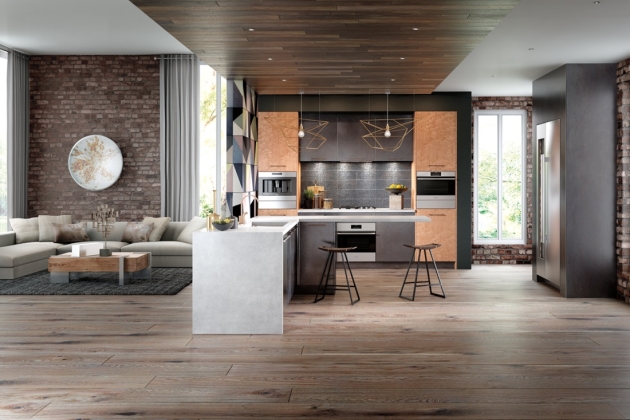
As with most appliances, choosing between smart wall ovens and traditional models depends on the household’s cooking style. Smart wall ovens come with an app-control feature as well as alerts, guided cooking, and the ability to monitor the oven remotely if the model supports these features. On the other hand, if a buyer likes a hands-on cooking experience and prefers straightforward controls, then a traditional wall oven may be better.
Smart features aren’t the only concern when choosing a wall oven. Factors such as the oven’s size, cabinet compatibility, cooking methods, available space for opening the oven door, and electrical setup can all significantly impact daily use. Homeowners should compare these things before cabinets get built or electrical work begins.
This guide helps homeowners understand how different models can affect the way you cook and how they might work best in your kitchen.
What Makes a Wall Oven Smart?
Smart wall ovens combine standard oven functions with advanced tools that make cooking a more manageable task. Built-in tools can include app connectivity, guided cooking, remote monitoring, notifications, and customizable oven cooking modes. Each oven is different, so always check the product details and the user manual.
App Connectivity
Some wall ovens can connect to a brand’s app via Wi-Fi, and users can see the status, set and manage timers, access the settings, and control all the functions of the oven from their mobile devices. Bosch wall ovens are good examples of wall ovens that offer connected and built-in features.
Remote Monitoring
Remote monitoring allows users to check the oven remotely without opening the door. Users can monitor the selected temperature, check if the oven is on, and see the time remaining. This is convenient for users preparing multiple things or multitasking in the house.
Helpful Alerts
Connected ovens are able to provide real-time notifications to the user once the preheat, a timer, or a cycle is complete. Users can more efficiently manage their time during meal preparation. Notifications, however, do not replace checking on food, following safe practices, or remaining nearby when the recipe requires close attention.
Guided Cooking
Guided cooking helps select cooking modes, temperatures, rack positions, and estimated cook times for various foods. Some high-end appliances, like certain Wolf wall ovens, offer cooking modes that provide guidance and support for different dishes. Available guidance and modes can vary with each model.
Stored Cooking Modes
Some smart ovens offer the ability to save settings for dishes you make regularly, including settings for pizza, bread, roasted veggies, or casseroles. This feature can result in less time setting up the oven to cook. Buyers should confirm which stored-mode options are included before choosing an oven.
Traditional Wall Ovens: Simpler Controls, Familiar Workflow
Traditional wall ovens are preferred by some customers for their familiar controls and ease of use. Wall ovens may feature knobs, buttons, touch controls, or a combination of control methods. They can still offer useful cooking modes without requiring app setup or a Wi-Fi connection.
Familiar and Direct Controls
Many buyers prefer controls that they are already familiar with. Buyers can select a cooking mode, set a temperature, and start the oven without the need to open an app. This may be helpful for guests as well as older family members that are not as technically savvy.
Simple Daily Operation
In comparison to smart-connected ovens, traditional controls may feel less advanced but make cooking simpler and more direct. These controls do not require the creation of an online account or connecting the oven to Wi-Fi and learning how to use a mobile app.
Perception of Better Reliability
Some buyers believe that having fewer connected features could lead to fewer long-term issues. A non-connected oven doesn’t need the internet, updates, or tech support to cook. Even though simpler controls may seem easier, they don’t guarantee better reliability, as build quality and care also matter.
Straightforward Cooking Modes
Traditional wall ovens offer many different modes, including bake, broil, roast, and convection, plus proof and self-clean options. Some models even include a temperature probe. Customers should look at all the modes and available features due to the advanced cooking options available on traditional ovens, even without connectivity.
Easy for the Whole Household
A good oven for a family should have simple controls. Ovens with complex features can be difficult to program and intend for only one person to operate. Simple controls are useful for family kitchens where several people need to use oven multiple times a day to prepare food.
Cooking Modes That Actually Matter
An oven with multiple cooking modes may seem attractive, but what matters most is how well that oven can cook the food that your family eats on a regular basis. Make sure to check the specs on a product page and the owner’s manual, as features vary from model to model.
Convection
A convection wall oven features uses a fan to circulate heated air, ensuring even cooking and consistent browning of foods. Some models allow for bake or roast settings that are used to provide convection with or without browning. Always check how individual modes work before buying an oven.
Proofing
A proofing setting provides a warm environment to help dough rise. This may be useful for people who make breads, rolls, or pizza. Temperature settings may differ, so check closely the manual and instructions for the individual models you are considering.
Broil
The broil setting works best for browning the tops of foods and equally for cooking thin foods. It is important to note that using this setting may cause some foods to brown very quickly, so always pay close attention when using this setting.
Roast
Roast mode is ideal for browning meats and vegetables that require a deeper level of browning. Some ovens provide convection roasting, which uses a fan to help circulate the hot air throughout the browning process. Results depend on food size, cookware, rack position, and selected temperature during cooking at home.
Temperature Probe
A temperature probe measures the internal temperature of food while cooking. Some models may even show progress and stop cooking when that temperature is reached. However, proper food safety precautions should still be taken while using the probe.
Self-Cleaning
Some models offer a self-cleaning option. This option uses high-temperature steam to remove food residue from the oven. The self-cleaning function takes a significant amount of time and most likely requires the owner to manually remove food parts, provide appropriate ventilation, and follow the instruction manual.
Guided Cooking
Guided cooking systems provide recommendations for mode, temperature, and time based on the food selected. While guided cooking simplifies the process of selecting settings, it cannot assess the final cooking results. The users are still responsible for preparing and cooking the food correctly and checking for doneness before serving.
Cabinet Fit, Electrical Planning, and Door Clearance
Accurate planning is imperative when considering a wall oven, as it is essentially built into a cabinet. What looks to be a seamless fit online can actually be more complicated when it comes to the clearance and cutout for the oven, support, wiring, and even the space for the door.
Single and Double Wall Ovens
A single wall oven has one cavity with space for other appliances, drawers, or cabinets. This setup can work for someone who usually makes one dish at a time or someone with a small family.
A double wall oven has two cooking cavities, so it may be convenient for households that regularly cook large meals or for households where dishes regularly require different temperatures. Like single wall ovens, double wall ovens require adequate structural support and power supply.
Replacing a single oven with a double wall oven is not as simple as swapping one for the other. The space surrounding the oven may require major modifications, and storage near the oven may be moved or lost. Additionally, a professional electrician must also review the electrical layout.
Cutout Dimensions and Trim
Cabinet plans need more than the outer width of an oven. Designers require the manufacturer’s installation guide with measurements for the specific model to confirm the cutout dimensions, size, and surrounding area with the required supports.
Trim is often used to enhance a cabinet finish, but should not be used to hide a poor cabinet opening. Cabinet makers should take the details and specifications of the appliance prior to starting work on the cabinet.
The built-in oven cabinet should accommodate the appliance according to the installation instructions. It should not be purchased based on the size of the previous unit. Even if two units have the same size label, they should not be treated as the same.
Electrical Requirements
Electrical needs vary by oven type and model. Never guess the size of the circuit, how it connects, or how much power it draws by looking at the oven.
Before purchasing a wall oven, a trained electrician should compare the given installation guide to the home’s wiring, the main electrical panel, the local building code, and the planned location of the wall oven. This should be done early in the process, as changes to the electrical system can affect the budget and the timeline for the remodel.
Door Swing and Working Space
Oven doors must have adequate clear space for safe, easy loading and unloading. Designers must consider the distance of the door to islands, countertops, walkways, and dining areas to avoid congestion during regular use and busier mealtimes.
Standard drop-down doors and side-opening doors create unique movement patterns. Side-opening doors may provide a better movement pattern in some kitchens, while drop-down doors work best when space in front is clear and unobstructed.
Handles can extend into narrow walkways even with correct placement inside the cabinet. Make sure drawers, cabinet doors, and handles have clearance with no contact. Check all clearances before finalizing the layout.
Which Wall Oven Fits Your Kitchen Best?
When buying an oven, consider who will use it, what they will cook, and how much space they have. Here are some buyer personas to consider before premium kitchen appliance planning:
- Everyday cook: A traditional or smart oven that has reliable basic functioning modes, clear controls, and easy-to-clean surfaces is sufficient for everyday cooking; additionally, consider functions that can be used on a weekly or monthly basis.
- Frequent baker: Consider convection modes and the position of racks, proofing options, temperature control, and the layout of cavities if you are a frequent baker. A temperature probe can also be useful for some recipes.
- Regular entertainer: If you like to entertain, a double wall oven may be a worthy investment because of the flexibility of having two ovens that can be set to different cooking settings. Ensure that the rest of the kitchen can accommodate the wall oven.
- Smart-home user: A connected oven may work for you if you’re comfortable using apps to set reminders, customize oven settings, and control cooking programs. Check your phone’s compatibility and account needs and see what the app can do.
- Minimalist kitchen: For some homeowners, choosing simple controls and a clean front can be more important than having a long list of features. Consider the adjacent cabinet style, display design, door style, handle style, and linear-style cabinetry if you are one of them.
- Family kitchen: For family kitchens, ease of use and safety are important. Convenience features like rack access and capacity should also be considered. When considering family kitchen layouts, appliances should be installed at the height that best serves every member of the family.
At Universal Appliance and Kitchen Center, homeowners can compare different formats, types of controls, and luxury cooking appliances. Our expert team can also assist in connecting the selected appliances to the cabinet planning and the kitchen’s usage.
Frequently Asked Questions
Are smart wall ovens worth it?
Smart wall ovens are useful if you use app alerts, remote control, or guided cooking technology. Simpler models may be more appropriate for buyers who don’t need these features.
What is the difference between a convection wall oven and a traditional wall oven?
A convection wall oven uses a fan to circulate air. A traditional wall oven may use a standard bake, although most traditional wall ovens offer a convection setting.
Can a single wall oven be replaced with a double wall oven?
Replacing a single wall oven with a double wall oven will probably require some cabinet changes and electrical work as well as added support. Make sure to check the installation guide for the selected model.
What should I measure before buying a built-in wall oven?
Measure the cabinet opening height, width, and depth. Additionally, please also verify the support, trim, ventilation, and the clearance and projection for the handles and doors as outlined in the installation guide.
Plan the Wall Oven Around the Whole Kitchen
Homeowners looking to remodel their kitchen can browse luxury cooking appliances, including wall ovens, at UAKC.net. This helps simplify the process of choosing an option with the right combination of controls, cooking methods, and oven configurations to meet regular kitchen needs and plans.
If you want to get expert assistance in matching the right product to your kitchen cabinets and space, feel free to visit or contact Universal Appliance and Kitchen Center. Our staff can help evaluate how the placement of the oven and door access affects the household’s everyday cooking workflow and comfort during regular meal preparation at home.
Universal Appliance and Kitchen Center’s guidance can help homeowners, remodelers, and even kitchen designers determine the best kitchen wall oven based on the style and format of the kitchen cabinets and how well the selected model can support household cooking.