
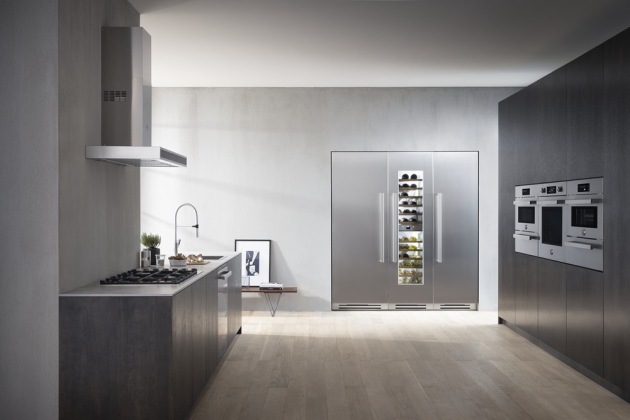
Designing a high-end kitchen requires a deep understanding of architectural millwork. Today’s modern kitchen is more than a place to prepare food. It is the social heart of the home. Achieving a flawless look depends on how you choose to integrate your machinery. When selecting luxury cooking appliances, homeowners must decide between two primary panel-ready formats: integrated and overlay.
The primary difference between integrated and overlay appliances is that integrated units sit completely flush with your cabinetry and use articulating hinges to hide the frame, whereas overlay units feature a brand visible frame and sit proud of the cabinet line.
This distinction determines whether your kitchen looks like a collection of high-end tools or a seamless piece of bespoke furniture. This guide explains the differences between integrated and overlay appliances. You will also learn how cabinet depth, hinge systems, ventilation, and installation all contribute to a seamless custom kitchen.
Defining the Aesthetics: The Core Architectural Differences
The primary distinction between integrated vs overlay appliances lies in their profile relative to the cabinet plane.
An overlay appliance is designed to have a custom panel attached to its face, but the unit itself still occupies a traditional footprint. This means the brand’s metal frame, or the door’s edges, will often remain visible. The appliance sits “proud” of the cabinetry, creating a slight protrusion that breaks the flat plane of the kitchen wall.
In contrast, true hidden kitchen appliances use integrated technology to vanish entirely. There are no exposed metal flanges or visible vents on the face of the unit. When closed, a true panel-ready refrigerator in an integrated configuration is indistinguishable from a standard tall pantry cabinet. The goal here is total visual erasure. This creates a consistent gap between cabinet doors across the entire run of millwork.
Overlay units are often preferred in traditional or transitional designs where a bit of depth adds character. However, modern and ultra-luxury minimalist designs almost exclusively demand integrated formats. These units allow the wood grain texture or paint finish to take center stage. By removing the visual “noise” of appliance hardware, the kitchen feels more like a living room and less like a laboratory.
Mechanical Engineering: Hinge Rotation and Cabinet Depth Realities
The “magic” of an integrated appliance is not just in the door panel. It is located within the hinge. Standard overlay units use a single pivot hinge. As the door opens, it swings out and wide. This requires the door to sit in front of the cabinet frame to avoid hitting the adjacent woodwork. If you tried to install an overlay unit flush with the cabinet, the door would hit the cabinet frame when opened.
Integrated engineering solves this with a complex, multi-axis articulating hinge. This dual-pivot motion first pulls the door panel forward and away from the opening. Then, it rotates the panel clear of the adjacent cabinet edges. This sophisticated movement is what allows for the tight tolerances seen in high-end luxury cooking appliances.
To visualize how these two setups differ in your floor plan, consider the following depth profiles:
[Standard Overlay Setup] —> 24″ Cabinet Depth + 2″ Appliance Door/Panel Projection = Proud Finish
[True Integrated Setup] —> 24″ Deep Cabinet (Includes fully recessed appliance and panel) = 100% Flush Finish
Architects must plan for these depths during the early framing stages. An integrated unit requires a full 24-inch to 25-inch clear opening depth to swallow both the appliance body and the custom ¾ inch decorative panel. If the cabinet carcass is too shallow, the “integrated” look is compromised immediately.
Design Execution: Minimizing Reveals and Cabinet Gaps
Precision is the hallmark of a luxury kitchen. When planning modular kitchen design, the width of the gaps between doors, known as reveals, must be consistent. Integrated appliances are engineered to maintain a minuscule reveal, often as small as 1/8 of an inch. This matches the standard spacing used by premium European cabinetry brands.
Standard overlay units usually require larger gaps. Because the door swings on a simpler arc, it needs “air” to move without catching. This results in wider, inconsistent black lines around the appliance. These gaps signal to the eye that a machine is hidden there. In cohesive built-in refrigeration layouts, the goal is to eliminate these clues.
Achieving a ⅛ inch reveal requires a master finish carpenter. The custom panels must be sized to the exact millimeter. Furthermore, the appliance must be leveled perfectly within the cabinet opening. Even a slight tilt will cause the narrow reveals to look crooked. Integrated units feature heavy-duty leveling legs and adjustment brackets specifically designed to fine-tune the panel position after installation.
Technical Specifications Matrix: Cabinetry & Clearance Tolerances
The following guide serves as a quantitative baseline for architects and custom cabinet makers when specifying integrated vs overlay appliances.
| Engineering Attribute | Overlay Appliance Configuration | Integrated Appliance Configuration | Impact on Custom Millwork |
| Door Trim & Frame Visibility | The surrounding metal frame or chassis flange remains partially exposed | Entirely hidden behind custom panels, zero metal visible from the front | Integrated offers absolute visual concealment |
| Required Opening Depth | Standard 24″ Depth (Appliance door panel sits proud of the opening) | 24 to 25 Inches (Entire unit and custom panel sit completely recessed) | Integrated requires planning for precise internal box depths |
| Hinge Mechanism Style | Standard single pivot hinge (requires clearance space to swing outward) | Articulating, multi axis dual pivot hinge (swings panel clear of edges) | Integrated hinges permit a tight ⅛ inch perimeter cabinet reveal |
The Role of Ventilation in Panel Ready Design
A common mistake in custom kitchen design is neglecting the “breathability” of the appliance. All refrigerators and dishwashers generate heat. Traditional freestanding or overlay units often vent through a visible kickplate at the bottom. This metal grille can disrupt the look of a continuous wood baseboard.
Integrated luxury cooking appliances are engineered with advanced airflow systems. Many premium models draw air in and push it out through the bottom, allowing for a custom cut wood toe kick. This means your kitchen baseboards can run uninterrupted beneath the refrigerator.
However, this requires the cabinetmaker to adhere to strict airflow requirements. If the custom toe kick does not have the proper square inches of open space, the compressor will overheat. This leads to premature appliance failure and may void the manufacturer’s warranty. Always ensure your installer understands the specific cubic feet per minute (CFM) requirements for your chosen model.
Comparing Panel Ready Dishwashers and Specialized Units
While refrigeration is the most common application for these styles, dishwashers and wine columns follow similar rules. A panel-ready dishwasher in an overlay format will have a visible control panel on the front. This is often referred to as a “semi-integrated” look. While convenient, it breaks the visual plane.
Fully integrated dishwashers move the controls to the top edge of the door. When the door is closed, the controls are hidden under the countertop. Some ultra-luxury models project a small light or timer onto the floor to see the remaining cycle time. This provides functionality without sacrificing the hidden kitchen appliances aesthetic.
Wine columns and beverage centers also benefit from integrated design. These units often feature glass panels. An integrated glass door unit will have a wood frame that sits perfectly flush with adjacent solid doors. This creates a “vitrine” effect, making it look more like a custom display case than a cooling unit.
FAQs about Integrated vs Overlay Appliances
Can any panel-ready refrigerator be installed to look completely integrated?
No, you cannot force an overlay unit to look integrated. Overlay units lack the articulating hinges required for flush installation. If you attempt to recess an overlay unit, the door will hit the cabinetry when opened. You must purchase a unit specifically labeled as “Integrated” to achieve a 100% flush finish.
Why do integrated luxury appliances carry a price premium over overlay models?
Integrated units require more advanced engineering. The multi-axis articulating hinges are expensive to manufacture and must support the weight of heavy custom panels. Additionally, the internal cooling systems are redesigned to be more compact, fitting the panel within a standard 24-inch depth.
Do integrated dishwashers or refrigerators require specialized custom cabinet handles?
While you can use standard pulls, integrated units often require more force to open due to their airtight seals. Designers recommend using “appliance pulls,” which are larger and sturdier than standard cabinet hardware. For a truly handle-less look, some luxury brands offer “push to open” technology, which uses a motor to pop the door open with a simple tap.
Pre-Installation Auditing: Avoiding Costly Cabinetry Errors
The transition from design to reality is where most panel ready projects fail. It is not enough to look at a brochure. Architects and millworkers must cross-reference the official Wolf technical design specifications prior to rough-in cabinetry fabrication.
Standard ¾ inch panels are the norm, but some high-end designs use thicker wood or even stone veneers. These materials add weight and thickness that can interfere with the hinge’s rotation arc. Miscalculating an integrated panel clearance by even 1/16 of an inch can cause mechanical friction, binding doors, or ruined custom panel edges.
Before the cabinets are built, a “site audit” should be performed. This involves verifying that the electrical and plumbing connections are recessed into the floor or adjacent cabinets. If a plug sticks out two inches behind the fridge, your “integrated” unit will suddenly become an “overlay” unit by default.
Longevity and Maintenance of Hidden Panels
Custom wood panels represent a significant investment. When you attach these panels to a cooling appliance, you expose them to moisture and constant temperature changes. Integrated units handle these challenges effectively because they seal tightly against the cabinetry. To prevent warping over time, you must ensure your cabinet maker finishes the wood on every surface, including the back.
Consider cleaning requirements as well. Wood panels hide fingerprints better than stainless steel, but oils still accumulate. As you select handles for your luxury cooking appliances, evaluate the “reach in” clearance. If you mount the handle too close to the panel, fingernails will eventually scratch the wood finish.
Finally, plan for the future. If you replace the appliance later, you might need new panels. Manufacturers often change hinge locations between generations, even when they maintain standard dimensions. Ask your cabinet maker for extra matching veneer or paint now. This allows you to remake a matching panel easily if needed.
Refine Your Architectural Vision at Universal Appliance and Kitchen Center
Selecting the right appliance format is the foundation of a successful kitchen remodel. The choice between integrated and overlay will dictate your cabinet shop drawings, your electrical layout, and the ultimate feel of your home.
Whether you are aiming for a classic professional look or a minimalist hidden sanctuary, seeing these units in person is essential. We invite you to visit a Universal Appliance and Kitchen Center showroom. You can experience the smooth articulating motion of integrated hinges and compare finishes side by side.
Schedule a precise design consultation with our premium corporate product specialists today. We will help you navigate the technical specifications to ensure your kitchen is as functional as it is beautiful.