
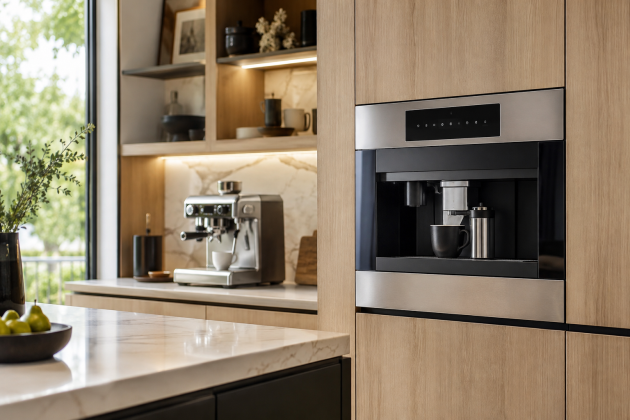
A premium coffee station has become one of the most requested features in luxury kitchen planning. For some homeowners, that means a built-in coffee machine integrated into tall cabinetry. For others, it means a high-quality countertop espresso machine with a grinder, accessories, and a dedicated prep zone.
Quick Answer: Is a Built-In Coffee Machine or Countertop Espresso Machine Better?
A built-in coffee machine is usually better for a luxury kitchen when the goal is a clean, integrated appliance wall and a permanent coffee station. A countertop espresso machine is often better when flexibility, barista-style control, easier replacement, and lower installation complexity matter more. The right choice depends on how often you make coffee, how much counter space you have, whether plumbing is available, and how finished you want the kitchen to look.
Both options can belong in a premium home. The difference is not only coffee quality. It is also cabinet planning, utility access, cleaning habits, appliance visibility, daily workflow, and long-term service access. A built-in unit can feel architectural and convenient, while a countertop setup can feel more hands-on and adaptable.
This guide compares built-in coffee machines and countertop espresso machines from the perspective of a luxury kitchen remodel, including design, installation, maintenance, storage, and showroom decision-making.
How Built-In Coffee Machines Work in a Luxury Kitchen
A built-in coffee machine is designed to install into cabinetry, often in the same appliance wall as wall ovens, speed ovens, warming drawers, or refrigeration columns. It creates a dedicated coffee zone without occupying everyday counter space. Many models can make espresso, coffee, cappuccino, latte-style drinks, hot water, and milk-based beverages depending on the model.
The main design advantage is integration. The appliance has a fixed position, a finished trim appearance, and a more intentional relationship with surrounding cabinets. UAKC offers built-in coffee systems that can be planned into a premium appliance package during a remodel.
The main planning challenge is commitment. Cabinet dimensions, electrical access, water handling, door swing, height, trim alignment, and service clearance should be reviewed before the cabinet maker finalizes the appliance wall.
How Countertop Espresso Machines Fit the Kitchen
A countertop espresso machine sits on the work surface and can range from a compact automatic unit to a serious semi-automatic machine with a separate grinder. This format gives homeowners more flexibility because the appliance can be moved, replaced, upgraded, or relocated without rebuilding cabinetry.
The tradeoff is visual presence. A countertop espresso machine, grinder, knock box, cups, beans, filters, and cleaning supplies can become part of the daily kitchen view. That may be attractive in a coffee-focused household, but it can feel cluttered in a kitchen designed around clean architectural lines.
Countertop machines also need thoughtful placement. The station should be close to water, trash, storage, and power. If milk drinks are common, nearby refrigeration matters. If several people use the kitchen in the morning, the coffee area should not block the cooking zone, refrigerator path, or sink.
Built-In vs Countertop Espresso Machine Comparison Matrix
| Feature | Built-In Coffee Machine | Countertop Espresso Machine |
| Best Look | Integrated, permanent, clean appliance wall | Visible coffee bar or flexible counter setup |
| Counter Space | Keeps counters clearer | Uses counter space daily |
| Planning Needs | Requires cabinet, electrical, and service planning | Requires power, counter depth, and accessory storage |
| Flexibility | Less flexible after installation | Easier to move, replace, or upgrade |
| Best Buyer | Homeowner building a long-term luxury coffee station | Homeowner who wants hands-on control or easier changes |
Cabinet Planning, Plumbing, and Electrical Details
Built-in coffee machines should be treated like real built-in appliances, not small countertop gadgets. The cabinet opening must match the model specifications. The appliance height should be comfortable for loading beans, filling water, removing grounds, and cleaning the milk system. If the machine is too high, daily use becomes awkward. If it is too low, it can interrupt drawer storage or appliance-wall symmetry.
Some built-in coffee systems use a refillable water reservoir, while others may require or offer a plumbed connection depending on the model. That decision affects installation cost and long-term convenience. A plumbed unit can reduce refilling, but it adds coordination with the plumber and cabinet maker.
Countertop espresso machines avoid most cabinet cutout issues, but they still need adequate power, surface depth, clearance above the machine, and nearby storage. A machine with a grinder, cups, beans, and accessories can occupy more space than expected.
Design and Workflow Differences
A built-in coffee machine works best when the kitchen has a planned beverage zone. That may be near a refrigerator column, wine refrigerator, beverage center, pantry, or breakfast cabinet. The goal is to keep coffee traffic away from the primary cooking zone.
A countertop espresso setup works best when it has a dedicated landing area. The best coffee bars include storage for beans, filters, cups, spoons, towels, syrups, and cleaning supplies. Without that storage, the counter can become crowded quickly.
The decision should also consider household rhythm. If one person makes coffee quietly each morning, a compact coffee station may be enough. If several people make espresso drinks, hot water, tea, and breakfast at the same time, the station needs more clearance and better traffic planning.
Maintenance and Cleaning Expectations
Coffee appliances require regular care. Built-in machines can simplify the daily countertop view, but they still need cleaning, descaling, grounds removal, drip tray emptying, milk-system maintenance, and filter replacement where applicable. Because the appliance is installed into cabinetry, service access should be part of the original plan.
Countertop machines vary widely. Some automatic machines handle many steps internally. Semi-automatic machines may require more hands-on grinding, tamping, purging, wiping, and cleaning. That process can be enjoyable for coffee enthusiasts, but it is not always ideal for homeowners who want one-button convenience.
Before choosing either format, be realistic about who will clean the machine. A beautiful coffee station loses value if maintenance is ignored or if the accessories have no practical storage.
FAQs about Built-In Coffee Machines vs Countertop Espresso Machines
Are built-in coffee machines worth it?
A built-in coffee machine can be worth it in a luxury kitchen when it supports the design, saves counter space, and gets used daily. It is most worthwhile when the appliance is planned early with the cabinetry and appliance wall.
Does a built-in coffee machine need plumbing?
Some models use a refillable reservoir, while others may require or support a water connection. The exact requirement depends on the model, so the installation guide should be reviewed before cabinetry and plumbing are finalized.
Is countertop espresso better for serious coffee drinkers?
It can be. Many serious coffee drinkers like countertop espresso machines because they offer more hands-on control, grinder choices, and easier future upgrades. Built-in machines usually prioritize convenience and integration.
Where should a luxury kitchen coffee station go?
The best location is close to water, cups, trash, refrigeration, and pantry storage, while staying out of the main cooking path. In larger kitchens, a beverage zone or breakfast station often works well.
Pre-Purchase Checklist for Coffee Appliances
Before ordering, confirm the appliance width, height, depth, cabinet opening, electrical requirements, water requirements, ventilation or clearance needs, door swing, service access, and daily reach height. Also plan storage for cups, beans, filters, milk accessories, cleaning tablets, towels, and waste.
If choosing a countertop machine, measure the full station, not just the machine. Include the grinder, accessories, clearance above the water tank or bean hopper, and space for cups. If choosing a built-in machine, coordinate with the cabinet maker before the appliance wall is built.
The right coffee station should make the morning routine easier, not just make the kitchen look more expensive.
Refine Your Coffee Station at Universal Appliance and Kitchen Center
Choosing between a built-in coffee machine and a countertop espresso machine is easier when you can compare scale, finish, controls, cabinet placement, and related appliances in person. Online dimensions help, but coffee workflow is physical.
At Universal Appliance and Kitchen Center, homeowners, designers, and builders can coordinate premium kitchen appliances, refrigeration, cooking products, and coffee systems as part of one complete remodel plan. A showroom visit can clarify whether a built-in coffee appliance belongs in the cabinet wall or whether a flexible countertop coffee bar is the better fit.
Visit a Universal Appliance and Kitchen Center showroom to compare coffee appliance options and design a luxury kitchen coffee station that works for daily use, entertaining, and long-term ownership.