
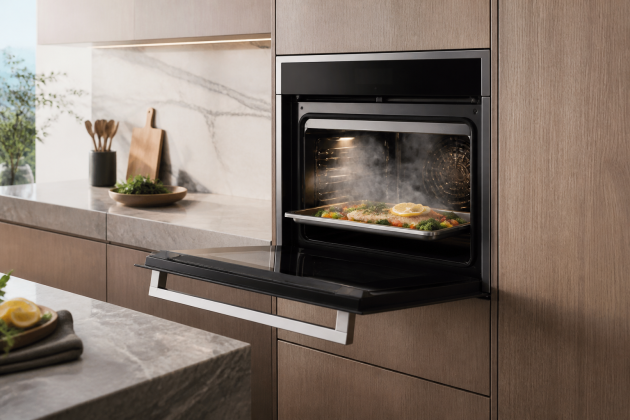
Steam ovens and speed ovens are two of the most useful premium cooking appliances for a modern luxury kitchen, but they solve different problems. A steam oven is designed for moisture, texture, reheating quality, vegetables, fish, grains, bread, and healthier cooking. A speed oven is designed for faster cooking by combining microwave energy with convection, broiling, or other heat sources.
Quick Answer: Should You Choose a Steam Oven or a Speed Oven?
Choose a steam oven if you want better moisture control, gentle reheating, vegetables with improved texture, fish, grains, proofing, and premium cooking flexibility. Choose a speed oven if you want a second oven that can also replace or reduce the need for a microwave while cooking foods faster than a traditional oven. In many luxury kitchens, the best answer is a wall oven stack that includes both.
A steam oven is best for quality-focused cooking. A speed oven is best for convenience-focused cooking. If your kitchen already has a full wall oven and you want healthier, more refined cooking, add steam. If your household needs fast meals, reheating, snacks, and flexible daily use, add speed. If space and budget allow, pairing a convection oven, steam oven, and speed oven creates a very capable premium cooking wall.
This guide compares steam ovens vs speed ovens by cooking style, installation, cabinet planning, electrical requirements, cleaning, daily use, and long-term value so you can choose the right appliance before your kitchen cabinets are built.
What Is a Steam Oven?
A steam oven cooks with moisture. Depending on the model, it may use pure steam, convection steam, or combi-steam cooking that blends steam with dry heat. This makes it useful for vegetables, fish, rice, grains, custards, reheating leftovers, proofing dough, and baking bread with a better crust and interior texture.
Miele describes a steam oven as a versatile supplement to an oven and cooktop, while combi-steam ovens combine the benefits of a steam oven with traditional oven operating modes. That distinction matters. A basic steam oven may focus mainly on steam, while a combi-steam oven can handle a broader range of baking, roasting, and moisture-controlled cooking.
Steam is especially valuable for reheating. Instead of drying food out, steam can restore moisture and texture. For households that cook high-quality meals, entertain often, or want better results from leftovers, this can be a major upgrade.
What Is a Speed Oven?
A speed oven is a compact built-in oven designed to cook faster by combining multiple cooking technologies. Many speed ovens use microwave energy with convection heat, broiling elements, or other heating methods. The goal is to reduce cooking time while producing better texture than a basic microwave.
UAKC has covered speed cooking technology, noting that speed ovens often combine cooking methods such as conventional electric elements, convection fans, microwaves, halogen lights, or air movement to produce faster results. This flexibility is why speed ovens are popular in busy luxury kitchens.
Wolf’s speed oven comparison notes that its speed oven is built-in and uses microwave power along with quartz broil and convection elements. In practical terms, that means a speed oven can often function as a microwave, compact convection oven, and fast cooking appliance in one location.
Steam Oven vs Speed Oven Comparison Matrix
| Feature | Steam Oven | Speed Oven |
| Primary Strength | Moisture control, gentle cooking, reheating quality | Fast cooking, microwave replacement, daily convenience |
| Best Foods | Vegetables, fish, grains, leftovers, bread, custards, proofing dough | Pizza, casseroles, snacks, reheating, roasting, quick weeknight meals |
| Cooking Style | Quality-focused and technique-driven | Convenience-focused and time-saving |
| Kitchen Role | Specialty oven or combi-steam oven in premium wall stack | Second oven and microwave alternative in a compact built-in format |
| Planning Priority | Water reservoir or plumbing, descaling, cabinet height, cleaning access | Electrical requirements, microwave-safe cookware rules, cabinet placement |
Cooking Performance: Moisture vs Speed
The biggest difference is cooking philosophy. A steam oven improves control over moisture. It can help food stay tender, reduce drying, and support techniques that are difficult in a standard oven. Vegetables can retain better texture. Fish can cook gently. Bread can benefit from steam during baking. Leftovers can reheat without becoming rubbery or dry.
A speed oven is built around time savings. It can heat, brown, crisp, and reheat more quickly than a conventional oven in many situations. It is especially useful for households that want one appliance to handle microwave tasks and compact oven tasks without placing a countertop microwave in the kitchen.
If the household cooks from scratch often and cares about texture, steam may deliver more culinary value. If the household wants faster meals and a cleaner built-in alternative to a microwave, speed may be the better first upgrade.
Where Each Appliance Fits in a Luxury Wall Oven Stack
Luxury kitchens often use a vertical cooking stack. This may include a primary wall oven, steam oven, speed oven, warming drawer, coffee system, or vacuum-sealing drawer. The challenge is not just choosing the appliances, but placing them at usable heights.
A speed oven often works well above or near a primary wall oven because it is used frequently for reheating and quick meals. It should not be placed so high that removing hot dishes becomes uncomfortable. A steam oven also needs ergonomic placement because water reservoirs, trays, and hot steam require careful handling.
If you are installing both, think through daily sequence. A household might use the speed oven every morning and afternoon, while the steam oven is used for dinner prep, vegetables, fish, bread, and reheating prepared meals. The most frequently used appliance should be easiest to access.
Installation and Utility Requirements
Both steam ovens and speed ovens require early cabinet planning. Width, height, depth, trim, handle alignment, door swing, electrical circuits, and ventilation instructions should be checked before ordering. Do not assume every 24-inch or 30-inch appliance fits the same opening.
Steam ovens may use a refillable water reservoir or a plumbed connection depending on the model. Reservoir models can be simpler to install, while plumbed models can be more convenient for frequent use. Descaling and drainage requirements should also be reviewed.
Speed ovens may have different electrical needs than a standard microwave. Wolf’s comparison notes differences between convection microwave and speed oven installation and electrical requirements, including built-in-only speed oven installation for the referenced Wolf speed oven. This is why a speed oven should be treated as a real built-in cooking appliance, not just a microwave with nicer trim.
Cleaning, Care, and Daily Ownership
Steam ovens need descaling, wiping, and moisture management. After steam cooking, the cavity may need to be dried. Water reservoirs should be cleaned as recommended. If the oven is plumbed, filter and maintenance requirements should be understood before installation.
Speed ovens require attention to cookware rules because microwave energy may be part of the cooking process. Some modes may allow metal racks, while microwave-only modes may not. Owners should understand which dishes, racks, pans, and accessories are appropriate for each cooking mode.
The best appliance is the one the household will actually use. A steam oven that sounds exciting but feels intimidating may sit idle. A speed oven may get daily use because it solves frequent meal and reheating needs. A showroom demonstration can make this difference much clearer.
When to Choose a Steam Oven First
Choose a steam oven first if cooking quality is the priority. It is especially useful for homeowners who cook vegetables, fish, grains, dumplings, eggs, custards, bread, and delicate reheated meals. It is also valuable for people who meal prep and want leftovers to taste closer to freshly cooked food.
A combi-steam oven is particularly compelling because it can combine steam with convection or dry heat. That can expand the appliance beyond basic steam cooking into roasting, baking, and more advanced techniques. If you enjoy learning new cooking methods, this appliance can become a serious culinary tool.
Steam also makes sense in wellness-oriented kitchens. It can support cooking with less added fat and can preserve texture in foods that are easy to overcook. For a premium kitchen, that is both practical and refined.
When to Choose a Speed Oven First
Choose a speed oven first if convenience is the priority. It is ideal for busy households that want faster meals, built-in reheating, snacks, frozen foods, small-batch baking, and a cleaner alternative to a countertop microwave.
A speed oven can also serve as a second oven for small dishes. Instead of heating a large oven for one tray or a quick lunch, the speed oven can handle the task more efficiently in day-to-day use. This makes it useful even in large kitchens with a full-size range or wall oven.
If the kitchen design does not include a visible microwave, a speed oven can preserve the premium look while keeping microwave functionality available. This is one reason speed ovens are common in luxury appliance packages.
FAQs about Steam Ovens vs Speed Ovens
Can a steam oven replace a microwave?
A steam oven can reheat many foods beautifully, but it does not replace a microwave for every task. It is better for moisture and texture, while a microwave or speed oven is usually faster for quick reheating and simple convenience.
Can a speed oven replace a regular oven?
A speed oven can act as a compact second oven for many tasks, but it usually does not fully replace a primary oven for large roasts, multiple sheet pans, or holiday cooking. It is best as a flexible companion appliance.
Is a combi-steam oven better than a regular steam oven?
A combi-steam oven is more versatile because it can combine steam with traditional oven modes. It is often the better choice for homeowners who want steam cooking plus baking and roasting flexibility in one appliance.
Do speed ovens make food crispy?
Many speed ovens can brown or crisp food better than a basic microwave because they may combine microwave energy with convection or broiling. Results depend on the model, mode, cookware, and food type.
Should a luxury kitchen have both a steam oven and a speed oven?
If space and budget allow, having both can be excellent. The steam oven supports refined cooking and reheating quality, while the speed oven supports fast daily cooking and microwave-style convenience. Together, they create a flexible premium cooking wall.
Pre-Purchase Auditing: Cabinetry, Power, Water, and Height
Before ordering either appliance, confirm the exact model number and installation guide. Check cutout dimensions, electrical circuit needs, trim style, door swing, handle projection, ventilation instructions, and whether surrounding appliances share the same design language.
For steam ovens, verify whether the unit is reservoir-based or plumbed. If it is plumbed, coordinate water access and any service requirements early. For speed ovens, confirm electrical requirements and understand whether the unit is intended for built-in installation only.
Height matters. Appliances that handle hot liquid, steam, or microwave-heated containers should not be placed too high. The best wall oven stack is not only beautiful; it is comfortable and safe to use.
Long-Term Value and Ownership Expectations
Steam ovens and speed ovens add value when they match the way the household cooks. A steam oven can elevate meal quality and make leftovers better. A speed oven can save time every day. Both can keep the kitchen cleaner by reducing the need for countertop appliances.
Long-term satisfaction depends on education. Ask how each mode works, what cookware is allowed, how cleaning is handled, and what maintenance is required. The more comfortable you are with the controls, the more often you will use the appliance.
These appliances are not just luxury extras. When chosen carefully, they can change how the kitchen functions every day.
Refine Your Premium Cooking Plan at Universal Appliance and Kitchen Center
The best way to choose between a steam oven and a speed oven is to compare them in person. Door movement, control panels, rack systems, cavity size, trim alignment, and installation height are easier to understand in a showroom than on a specification sheet.
At Universal Appliance and Kitchen Center, homeowners, designers, builders, and remodelers can explore premium cooking appliances, including speed ovens, wall ovens, steam options, and complete luxury appliance packages. A product specialist can help you decide whether your kitchen needs steam, speed, or both.
Visit a Universal Appliance and Kitchen Center showroom to compare premium cooking appliances and design a wall oven stack that supports the way you cook, reheat, entertain, and live every day.