
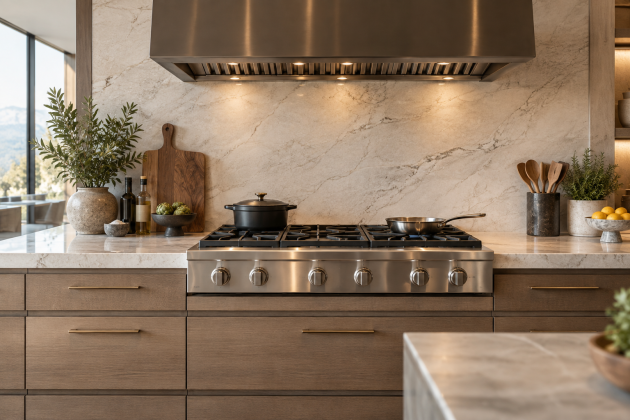
Choosing between a rangetop and a cooktop is one of the most important surface-cooking decisions in a custom kitchen. Both can deliver premium performance, but they affect cabinetry, ventilation, counter space, installation cost, and the way the cooking zone looks from across the room.
Quick Answer: Is a Rangetop or Cooktop Better?
A rangetop is usually better when the homeowner wants a professional cooking look, front-mounted controls, heavier grates, and a more substantial appliance presence under a hood. A cooktop is often better when the priority is a cleaner countertop line, easier cabinet flexibility, and a lighter built-in appearance. The better choice depends on cooking style, cabinet design, ventilation, fuel type, and how much visual weight the cooking surface should carry.
Both options can work in a luxury kitchen. The difference is not only performance. It is how the appliance integrates with counters, base cabinets, drawers, hoods, and daily cooking workflow.
What Is a Rangetop?
A rangetop is a built-in cooking appliance that resembles the top section of a professional range. It usually has front controls, substantial grates, and a deeper body that installs into the cabinet run. Rangetops are commonly selected for chef-inspired kitchens where the cooking wall is meant to feel strong and intentional.
Because the controls are on the front, a rangetop can feel more like a commercial cooking station. It also usually requires more cabinet planning than a drop-in cooktop. The cabinet below may need to be modified, and drawers under the appliance may be limited depending on the model.
UAKC carries cooktops and rangetops for homeowners comparing gas, induction, electric, and pro-style surface-cooking options.
What Is a Cooktop?
A cooktop is a built-in cooking surface that drops into a countertop cutout. Controls are usually on the top surface, although some models use touch controls or knob layouts. Cooktops can be gas, induction, radiant electric, or modular depending on the brand.
Cooktops are popular when the design goal is a cleaner counter line. They often allow more flexibility for drawers or storage below, although every model has its own clearance requirements. Induction cooktops are especially common in contemporary kitchens because they create a low-profile cooking surface.
Rangetop vs Cooktop Comparison Matrix
| Feature | Rangetop | Cooktop |
| Best Look | Professional, substantial, range-inspired | Clean, integrated, lower profile |
| Controls | Usually front-mounted knobs | Usually top controls or touch controls |
| Cabinet Impact | Requires more front cabinet planning | Often easier to integrate above drawers |
| Ventilation | Often paired with a stronger hood | Depends on fuel type and cooking output |
| Best Buyer | Serious cooks wanting a pro-style focal point | Homeowners wanting design flexibility and clean lines |
Performance and Cooking Style
Rangetops often appeal to homeowners who cook frequently and want a more tactile appliance. Heavy knobs, continuous grates, and high-output burners can make the cooking zone feel more robust. This can be useful for large cookware, frequent sauteing, simmering, and entertaining.
Cooktops can still offer strong performance. Gas cooktops provide familiar flame control, while induction cooktops offer fast response and a sleek surface. For many households, a premium cooktop delivers more than enough power without requiring the visual or cabinet commitment of a rangetop.
The best choice should match real cooking habits. If the appliance is a daily workhorse and the cooking wall is the center of the kitchen, a rangetop may make sense. If the kitchen needs a quieter built-in look, a cooktop may be the better fit.
Cabinet and Countertop Planning
Rangetops need careful cabinet planning because the appliance face sits at the front of the cabinet. The opening, support, side clearances, gas or electrical location, and ventilation path should be confirmed before cabinets are built.
Cooktops need a precise countertop cutout and required clearances below. Depending on the model, drawers may be possible beneath the appliance, but the installer must confirm heat shielding, depth, and utility conflicts.
Neither option should be selected after countertops are finalized. The model number should be chosen early so the cabinet maker, countertop fabricator, electrician, plumber, and installer are all working from the same specifications.
Ventilation Requirements
Surface cooking always needs ventilation planning. A rangetop with high-output burners may need a larger hood, higher CFM, and careful duct routing. The hood should usually be at least as wide as the cooking surface, and sometimes wider depending on cooking intensity and layout.
A cooktop may have lower ventilation demands, but that depends on fuel type and cooking behavior. Gas and high-heat cooking produce more combustion byproducts, moisture, odor, and grease. Island cooktops can also be harder to ventilate because cross-drafts and open-room airflow affect capture.
UAKC has also covered kitchen ventilation planning, which is useful before choosing a surface-cooking appliance.
Design Impact in a Luxury Kitchen
A rangetop creates a strong cooking station. It pairs naturally with a statement hood, stone backsplash, and symmetrical drawer bases. This is a good fit when the homeowner wants the cooking wall to feel like the centerpiece of the kitchen.
A cooktop is visually quieter. It can sit in a long countertop run, on an island, or above storage without creating as much appliance mass. This can be useful in modern kitchens where cabinetry and surfaces are meant to feel continuous.
FAQs about Rangetops vs Cooktops
Is a rangetop better than a cooktop?
A rangetop can be better for serious cooking and a professional design statement. A cooktop can be better for clean integration, cabinet flexibility, and a lower-profile kitchen design.
Can a rangetop go over drawers?
Sometimes, but many rangetops require more cabinet depth and clearance than a cooktop. Always confirm the model specifications before designing drawers below.
Is induction available as a cooktop?
Yes. Induction cooktops are widely available and are popular in luxury kitchens because they are responsive, efficient, and visually clean.
Does a rangetop need a stronger hood?
Often, yes. Many rangetops have higher-output burners, so hood size, CFM, ducting, and makeup air should be reviewed early.
Pre-Purchase Checklist
Before ordering, confirm appliance width, fuel type, countertop cutout, cabinet opening, drawer clearance, gas or electrical location, hood width, duct route, backsplash clearance, delivery path, and service access.
For rangetops, confirm front cabinet modifications and support requirements. For cooktops, confirm countertop material, cutout tolerances, and below-counter clearance.
Compare Rangetops and Cooktops at Universal Appliance and Kitchen Center
Choosing between a rangetop and cooktop is easier when you can compare appliance depth, burner layout, control placement, grate feel, induction options, and ventilation needs in person.
At Universal Appliance and Kitchen Center, homeowners, designers, and builders can review surface-cooking appliances as part of a complete kitchen plan. Visit a showroom to compare rangetops, cooktops, hoods, wall ovens, and full appliance packages before finalizing cabinetry and utilities.