
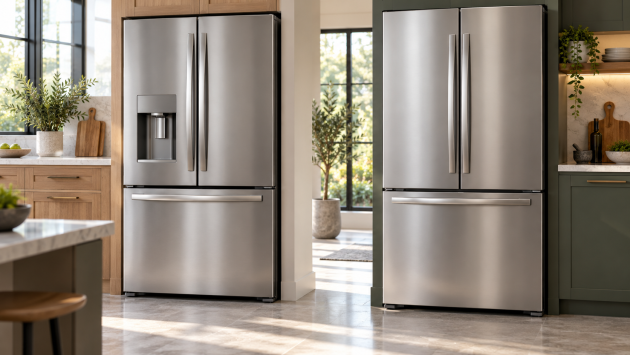
The water dispenser looks like a small detail until everyone in the house uses it ten times a day. It affects the refrigerator door, the space inside it, and the way people move through the kitchen. A model with the dispenser hidden inside is not automatically more luxurious; it solves a different problem from one you can use without opening the door.
Quick Answer: Internal or External Water Dispenser?
Choose an external dispenser when quick access to water and ice matters most, especially for a busy household. Choose an internal dispenser when you prefer an uninterrupted door front and do not mind opening the refrigerator to fill a glass. Compare the exact model’s ice arrangement, filter location, container clearance, and cleaning requirements. A refrigerator may have internal water but freezer ice, external water and ice, or another combination.
What Changes in Daily Use
An external dispenser is easy to reach on the way through the kitchen. Children and guests can fill a glass without opening the refrigerator. But the dispenser recess is visible, and drips or mineral spots may need regular wiping. Try your tallest reusable bottle under the opening. GE describes an extra-tall dispenser on selected models, a reminder that opening height is model-specific.
An internal dispenser leaves the outside of the door visually simpler. It can be a good match for a kitchen that treats the refrigerator as part of a calm cabinet wall. The tradeoff is opening the door, usually with one hand while holding a glass with the other. Stand at the appliance and test whether the button and spout are comfortable to use.
Compare More Than the Dispenser
| Question | Internal | External |
|---|---|---|
| Door appearance | Unbroken front | Visible dispenser recess |
| Access | Open the door first | Fill from outside |
| Cleaning | Wipe inside spout and shelf area | Wipe exterior recess and tray |
| Ice | Often a separate freezer-bin decision | May dispense through the door |
| Best test | Reach with a full glass | Fit your tallest bottle |
Door design is only one part of refrigerator fit. Ice equipment may take space from a shelf, a door bin, or a freezer compartment. Compare actual usable storage with the ice maker installed, not just cubic feet on the product page. Ask where the filter is and how often it must be changed. If a model is panel-ready, confirm whether the dispenser and panel configuration are compatible.
Plan the Water Connection
Both formats can require a water line and a replaceable filter. Check the exact installation instructions for supply location, shutoff access, tubing, and service clearance. A hose or outlet pushed behind the refrigerator can keep it from sitting at its intended depth. Our built-in versus freestanding refrigerator guide covers the larger cabinet-fit decision.
Frequently Asked Questions
Does an internal dispenser make a refrigerator more reliable?
Do not assume so. Reliability depends on the model and its water and ice system, not simply where the spout is placed. Compare service access and warranty information.
Can an external dispenser fill a large bottle?
Some can, but the opening height and sensor features vary. Bring your bottle dimensions to the showroom.
Does internal water mean there is no ice maker?
No. Many models pair an internal water spout with a separate ice maker or bin. Verify the arrangement on the model you are considering.
Choose the version that fits both the room and the people using it. A beautiful door matters; so does filling a glass without a daily nuisance.