
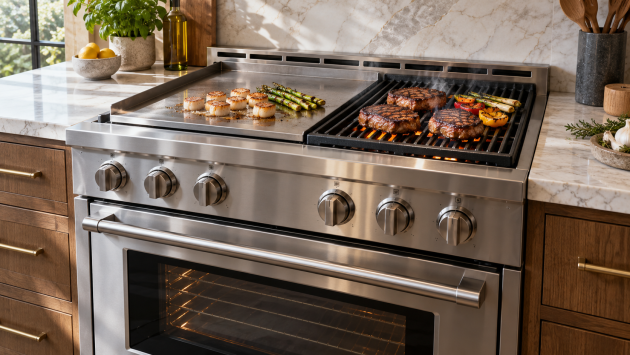
A pro-style range can make the cooking wall feel like the center of the house. Then comes the practical question: what belongs between the burners? A griddle promises Sunday breakfast and quick sandwiches. A charbroiler promises the sear and flavor of live grilling. Either one claims valuable surface area every day, including the days you do not use it.
Quick Answer: Griddle or Charbroiler?
Choose a griddle when pancakes, eggs, quesadillas, smash burgers, and other flat-surface meals are part of the regular routine. Choose a charbroiler when indoor grilling is something you will do often enough to justify the smoke, ventilation, and cleaning. Compare the exact range configuration: the specialty surface can replace burners, and available sizes and combinations vary by model. If neither will be used weekly, extra open burners may be more useful.
What a Griddle Does Best
The broad flat surface lets you cook several portions at once without juggling pans. It is useful for food that benefits from even contact, from breakfast to tortillas and grilled cheese. A built-in griddle also creates an easy landing zone for food that moves quickly from one side to the other. But it is not a spare countertop. It needs preheating, appropriate tools, and cleaning after use. Check whether the selected unit has a removable grease tray and what surface care the manufacturer recommends.
What a Charbroiler Changes
A charbroiler uses an open grate and a heat source beneath it to grill food indoors. Wolf offers range configurations with a charbroiler and griddle, but details differ across series. A charbroiler can be compelling for steaks, vegetables, and frequent grill cooks who do not want to step outside. It also creates more smoke and grease than a pan of eggs. Before treating it as a must-have, ask what the kitchen’s hood can capture and how the grate and grease system are cleaned.
Compare the Tradeoffs
| Decision | Griddle | Charbroiler |
|---|---|---|
| Common use | Breakfast, sandwiches, flat-top cooking | Steaks, skewers, vegetables, grill marks |
| Cooking surface | Continuous flat plate | Open grate |
| Ventilation | Plan for grease and cooking vapor | Plan for heavier smoke and grease |
| Cleanup | Plate and grease tray | Grate and grease components |
| Opportunity cost | May replace burners | May replace burners |
Start With Your Most Repeated Meal
Write down what you cooked last week, not only what you dream of cooking at a party. If the griddle would make five breakfasts easier, it has a strong case. If indoor grilling would happen twice a month while an outdoor grill is already steps away, the charbroiler may be less persuasive. Our 36-inch versus 48-inch range guide helps with the space decision.
Frequently Asked Questions
Can I have both a griddle and charbroiler?
Some large pro-style range configurations offer both. Check the exact model, remaining burner layout, and ventilation plan.
Does a charbroiler need a stronger hood?
It can produce substantial smoke and grease. Have a qualified kitchen professional size and place ventilation for the selected appliance and local requirements.
Is a built-in griddle easier than a countertop griddle?
It is always ready and can handle larger cooking sessions, but it permanently occupies range space and still needs care. Compare your actual use.
A specialty surface earns its place when it makes a familiar meal easier, not simply when it makes the range look more professional.