
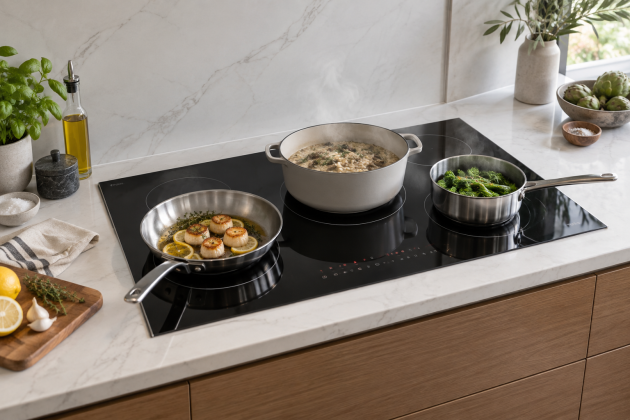
Six inches can sound minor until three pans are competing for the same stretch of glass. A wider induction cooktop may make a busy cooking night feel calmer. It may also take away the drawer space or landing counter that would have made the kitchen easier to use every day.
Quick Answer: 30-Inch or 36-Inch Induction Cooktop?
Choose a 30-inch induction cooktop when counter and base-cabinet space is tight, or when you usually cook with one or two pans at a time. Choose a 36-inch model when you routinely use several large pieces of cookware together and the kitchen can accommodate the larger cutout, ventilation plan, and electrical requirements. The extra width is useful only if the cooking-zone layout gives your own pans more usable space.
Count Pans, Not Circles
Two cooktops can each advertise four cooking zones while handling pots very differently. Look at the distance between zones, their shape, and whether a large skillet crowds the controls. Flexible induction areas may join zones for a griddle or long pan, but their availability and behavior are model-specific.
Thermador’s Liberty line is an example: its 30-inch cooktop has two extra-large flexible zones, while the 36-inch version has three. That difference is meaningful for someone who uses multiple wide pans. Another brand may use the additional width differently, so compare actual layouts rather than assuming every 36-inch unit adds the same feature.
Comparison at a Glance
| Decision | 30-Inch Cooktop | 36-Inch Cooktop |
|---|---|---|
| Best fit | Compact cooking walls and modest pan use | Frequent multi-pan cooking with larger cookware |
| Counter space | Preserves more landing room | Uses six more inches of the counter run |
| Zone layout | Can be excellent; inspect spacing | May offer more or larger zones, depending on model |
| Cabinet cutout | Must match the exact product’s installation instructions | |
| Electrical plan | Have an electrician verify the selected model’s circuit and connection requirements | |
Test the Way You Actually Cook
Think of a meal that puts pressure on your current cooktop. Perhaps a wide saute pan, a pasta pot, and a small saucepan all need heat at once. Put those pan sizes on a showroom cooktop if possible. A 36-inch surface may keep handles farther apart and give you more freedom to slide cookware between zones. If your usual dinner uses only one skillet and one pot, the wider model may not earn its cabinet space.
Induction also depends on compatible cookware. A magnet that holds firmly to the base is a useful first check, but flatness and pan diameter still matter. Bring the pans you care about or measure their bases before you compare zones.
Plan the Countertop Before Ordering
A cooktop is not a drop-in replacement based only on its nominal width. The cutout dimensions, countertop support, edge clearances, cabinet depth, and space below the unit are model-specific. A wider cooktop may affect drawer storage, an oven below, or the width of adjacent landing areas. Work from the current installation guide before the stone is cut.
Induction still needs ventilation for steam, grease, and smoke created by cooking. Confirm that the hood’s capture area suits the cooktop and the way you cook. Our induction planning guide covers cookware and utility questions more broadly.
Frequently Asked Questions
Does a 36-inch induction cooktop always have more burners?
No. Zone count and flexible-zone design vary by model. Compare the usable pan layout, not only the number in a product listing.
Can I replace a 30-inch cooktop with a 36-inch one?
Possibly, but it is a countertop and cabinet project, not a simple appliance swap. The new cutout, support, clearances, electrical supply, and hood alignment all need review.
Do I need a larger hood for a 36-inch induction cooktop?
Ventilation should be selected for the exact cooking surface, its location, and cooking habits. A qualified designer or installer should verify hood width, depth, mounting height, and ducting rather than assuming a fixed rule from the cooktop label.
Buy the width that lets your common pans coexist comfortably while preserving enough counter to prep and serve. The right cooktop is measured in better meals, not simply more glass.