
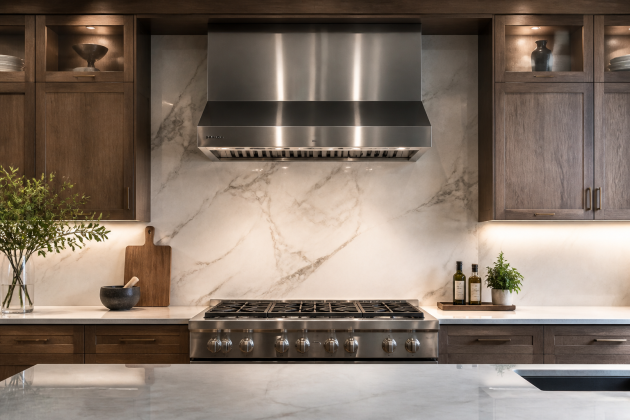
A range hood is one of the most important appliances in a luxury kitchen, even when it is not the first product homeowners notice. The right hood manages smoke, steam, grease, odor, heat, and cooking comfort. The wrong hood can make even an expensive range or cooktop frustrating to use.
Quick Answer: What Range Hood Is Best for a Luxury Kitchen?
The best range hood is the one that matches the cooking appliance, kitchen layout, duct route, cooking style, and design goal. Wall hoods are strong for standard cooking walls. Island hoods need more capture area because air moves around them. Inserts work well inside custom wood or plaster hoods. Downdraft ventilation is useful when overhead ventilation is not possible, but it is usually more limited for high-output cooking.
For luxury kitchens, ventilation should be selected at the same time as the range or cooktop. Hood width, depth, blower strength, duct size, makeup air, ceiling height, and cabinetry all affect performance.
This guide explains the major range hood types and the planning details that matter before cabinets, ceilings, or appliance orders are finalized.
Why Ventilation Belongs Early in the Appliance Plan
A premium cooking appliance can produce serious heat, smoke, grease, and odor. Larger burners, griddles, grills, and high-output ranges need ventilation that can capture cooking byproducts before they spread through the kitchen.
UAKC offers a large selection of range hoods, including professional, wall mount, insert, island, under-cabinet, ducted, ductless, convertible, and downdraft options. The correct category depends on the installation, not just the look.
Ventilation should be discussed before the cabinet layout is final. Changing hood width, duct route, or ceiling structure later can become expensive.
Wall Hoods, Island Hoods, Inserts, and Downdrafts
A wall hood mounts above a range or cooktop on a wall. This is one of the most common and effective configurations because the wall helps contain air movement around the cooking surface.
An island hood hangs above an island cooktop or range. Island hoods often need more capture area because they do not have a back wall to help contain smoke and steam. They also become a major visual element in the room.
A hood insert is the working ventilation unit installed inside a custom enclosure. Inserts are popular in luxury kitchens where the designer wants a plaster, wood, metal, or cabinetry-style hood. The insert must still be sized correctly behind the custom finish.
Downdraft ventilation pulls air downward near the cooking surface. It can be useful where overhead ventilation is not possible, but it should be reviewed carefully for high-output cooking, tall pots, and frequent searing.
Range Hood Comparison Matrix
| Hood Type | Best Fit | Planning Notes |
| Wall Hood | Ranges and cooktops on a cooking wall | Often strong capture because the wall helps contain air |
| Island Hood | Island cooking zones | Usually needs wider/deeper capture and careful visual planning |
| Insert | Custom hood enclosures | Requires coordination between appliance specs and custom finish |
| Under-Cabinet Hood | Compact cooking walls | Can work well when cabinet depth and ducting are compatible |
| Downdraft | Designs where overhead ventilation is not possible | Review limitations for high-output cooking and tall cookware |
Width, Depth, and Capture Area
A hood must capture the air rising from the cooking surface. Width and depth are just as important as blower strength. A powerful blower cannot fully compensate for a hood that is too shallow or poorly positioned.
For many cooking walls, the hood should be at least as wide as the cooking appliance. For high-output or island cooking, additional width may be recommended. Depth matters because smoke and steam do not rise in a perfect straight line.
When comparing hoods, review the exact cooking appliance below it. A 30-inch cooktop, 36-inch range, 48-inch range, grill, or griddle can each change the ventilation conversation.
Blower Strength, Ducting, and Makeup Air
CFM matters, but it is not the only number. Duct size, duct length, turns, exterior wall location, roof termination, blower type, and makeup air rules can all affect performance.
A larger blower may move more air, but it can also be louder or require larger ducting. Some homes may require makeup air when a high-capacity hood removes a large amount of air from the house. That should be reviewed with the contractor or HVAC professional.
Ducted ventilation is generally preferred for serious cooking because it exhausts air outdoors. Ductless or recirculating hoods can help in certain situations, but they rely on filters and do not remove heat and moisture the same way.
Design Choices: Stainless, Custom, Wood, and Plaster
A hood can be a design centerpiece. Stainless professional hoods pair well with pro-style ranges and performance-forward kitchens. Custom wood or plaster hoods can soften the cooking wall and help the appliance package feel more integrated.
For custom hoods, the decorative shell should never be designed separately from the insert. The insert must fit, capture correctly, allow service access, and meet installation requirements. Lighting, controls, filters, and cleaning access should all be considered.
If the hood is over an island, visual weight matters. The hood will be visible from multiple angles and can affect sightlines through the kitchen.
FAQs about Range Hoods
Is a ducted range hood better than ductless?
For most serious cooking, ducted ventilation is better because it moves smoke, steam, grease, odor, and heat outdoors. Ductless hoods can help where ducting is not possible, but they rely on filters and recirculate air.
How wide should a range hood be?
The hood should usually be at least as wide as the cooking appliance, and sometimes wider for high-output or island cooking. Exact guidance depends on the appliance and installation.
Do induction cooktops need range hoods?
Yes. Induction may produce less excess heat than gas, but cooking still creates steam, grease, smoke, and odor. Ventilation is still important.
Is downdraft ventilation good for luxury kitchens?
Downdraft can be useful when overhead ventilation is not possible, but it should be reviewed carefully for high-output cooking, large cookware, and frequent searing.
Pre-Purchase Ventilation Checklist
Before ordering a hood, confirm cooking appliance width, burner output, hood width, hood depth, mounting height, blower type, duct size, duct route, exterior termination, noise expectations, filter access, makeup air requirements, cabinet clearances, and lighting placement.
Do not choose the hood only by style. The best luxury kitchens make the ventilation look intentional and perform quietly enough for everyday use.
Refine Your Kitchen Ventilation Plan at Universal Appliance and Kitchen Center
At Universal Appliance and Kitchen Center, homeowners, designers, builders, and remodelers can compare cooking appliances and ventilation options together. That matters because the range, cooktop, hood, cabinetry, and duct route all need to work as one system.
Visit a Universal Appliance and Kitchen Center showroom to compare wall hoods, island hoods, inserts, downdrafts, and premium cooking appliances before finalizing your luxury kitchen plan.