
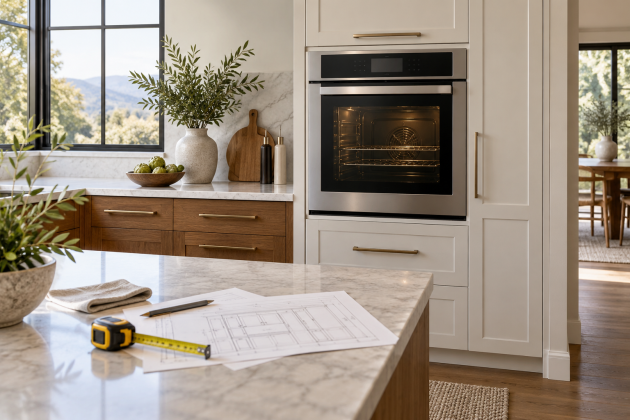
A wall oven can look perfectly proportioned in a showroom and still be the wrong size for your kitchen. The important number is not only the width on the label. It is the space inside the oven, the opening in the cabinet, and the room you have to move around its open door.
Quick Answer: 24-Inch or 30-Inch Wall Oven?
Choose a 24-inch wall oven when a compact cabinet layout or an existing cutout makes that size the sensible fit, and your regular pans fit its cavity. Choose a 30-inch wall oven when you cook with larger roasting pans, entertain often, or have the freedom to design the cabinet around a wider oven. Neither size guarantees a particular cooking mode or door style. Compare exact models and installation sheets before committing.
What the Width Actually Tells You
The nominal width describes the appliance category, not the usable width of its racks. For perspective, Bosch’s wall-oven comparison lists a 24-inch single oven at 2.8 cubic feet and a 30-inch single oven at 4.6 cubic feet. Those are examples, not a rule for every brand. Cavity shape, rack positions, and door design determine what you can actually cook.
Bring the dimensions of the largest roasting pan, baking sheet, Dutch oven, or pizza steel you use. Measure handles too. A capacity number will not tell you whether a handled pan clears the door or leaves enough room for air to circulate.
Side-by-Side Planning Guide
| Decision | 24-Inch Oven | 30-Inch Oven |
|---|---|---|
| Best fit | Compact layouts and some existing smaller openings | Larger cabinet runs and frequent cooking with wide pans |
| Cooking space | Check your actual pans and rack clearances carefully | Usually offers more cavity volume, depending on model |
| Replacement | May simplify a like-for-like small-oven replacement | May require substantial cabinet changes if replacing a narrow oven |
| Design | Can preserve adjacent storage in a tight kitchen | Creates a broader visual anchor in an appliance wall |
| Installation | Both require model-specific cutout, ventilation, and electrical checks | |
Replacing an Existing Oven Is a Cabinet Project
If you are replacing an oven, start with the opening you already have. Measure its width, height, and depth after removing any trim that obscures the cabinet edges. Then compare those measurements with the new oven’s installation instructions. An advertised 30-inch oven does not automatically fit every old 30-inch cutout, and the same is true at 24 inches.
Look at the surrounding cabinet, too. Enlarging an opening may remove structural material or leave too little clearance to an adjacent drawer or refrigerator door. A flush installation can require different dimensions from a standard installation. Bosch’s buying guidance makes this distinction explicit: use the product specification sheet, not the appliance’s nominal size, to check the opening.
Electrical supply is another part of the decision. Have a qualified installer confirm the circuit, junction-box position, and access required by the specific model. Avoid ordering cabinetry or modifying wiring from a marketing photo.
Think Through a Real Cooking Day
A smaller oven may be entirely comfortable for weeknight baking, a casserole, and one roasting pan. It becomes less forgiving when two large trays must cook at once or holiday cookware has to fit. A wider cavity is useful only if you have the cabinet space and will actually use that room.
Door swing deserves as much attention as oven width. Bosch offers some 30-inch ovens with side-opening doors as well as the familiar drop-down design. The best choice depends on how close the oven sits to an island or walkway and whether you can reach a heavy dish without leaning over an open door. Verify the exact hinge configuration and clearances for the model you select.
For a broader look at where the oven belongs, see our wall ovens versus ranges kitchen-layout guide.
Questions to Settle Before You Buy
- What are the finished cabinet opening dimensions, not just the old appliance dimensions?
- Do your largest pans fit on the intended racks with usable clearance?
- Will the open door obstruct an island, drawer, or traffic path?
- Is the cabinet designed for a standard or flush installation?
- Has the electrical connection been checked against the new model’s instructions?
Frequently Asked Questions
Is a 24-inch wall oven too small for everyday cooking?
Not necessarily. It can handle everyday meals well if your cookware fits and you rarely need multiple large trays at once. Measure the items you already own rather than judging by the nominal width alone.
Can a 30-inch wall oven replace a 24-inch one?
Usually not as a simple swap. A wider unit generally needs a wider opening and may affect adjacent cabinetry, clearances, and electrical placement. Review the installation sheet with your cabinetmaker and installer first.
Does a 30-inch wall oven cook better?
Width alone does not determine cooking quality. Compare convection performance, controls, racks, temperature features, and service support in the exact models under consideration. The larger size primarily gives you more room to work with.
The right wall oven is the one that fits both your cabinets and the food you actually make. Settle those two questions before deciding which finish looks best.